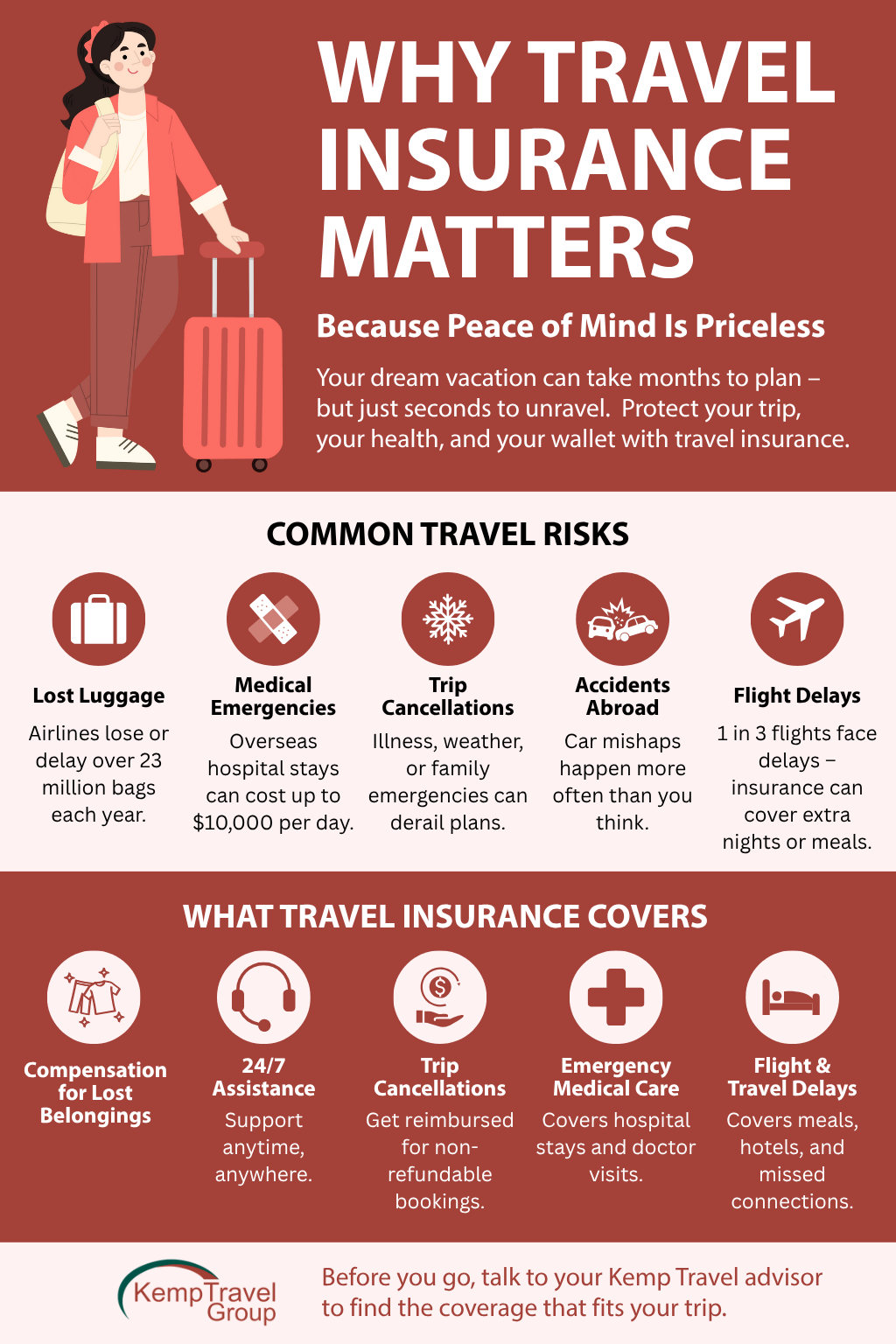
Click the image below to view the document in full size.
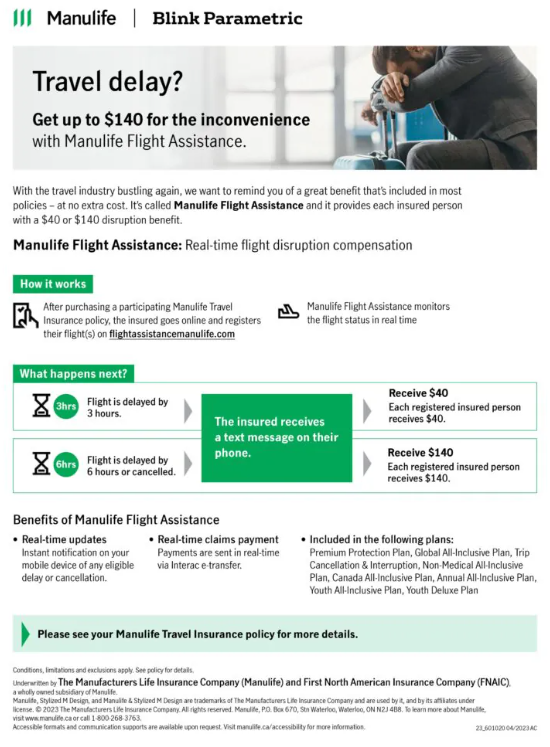
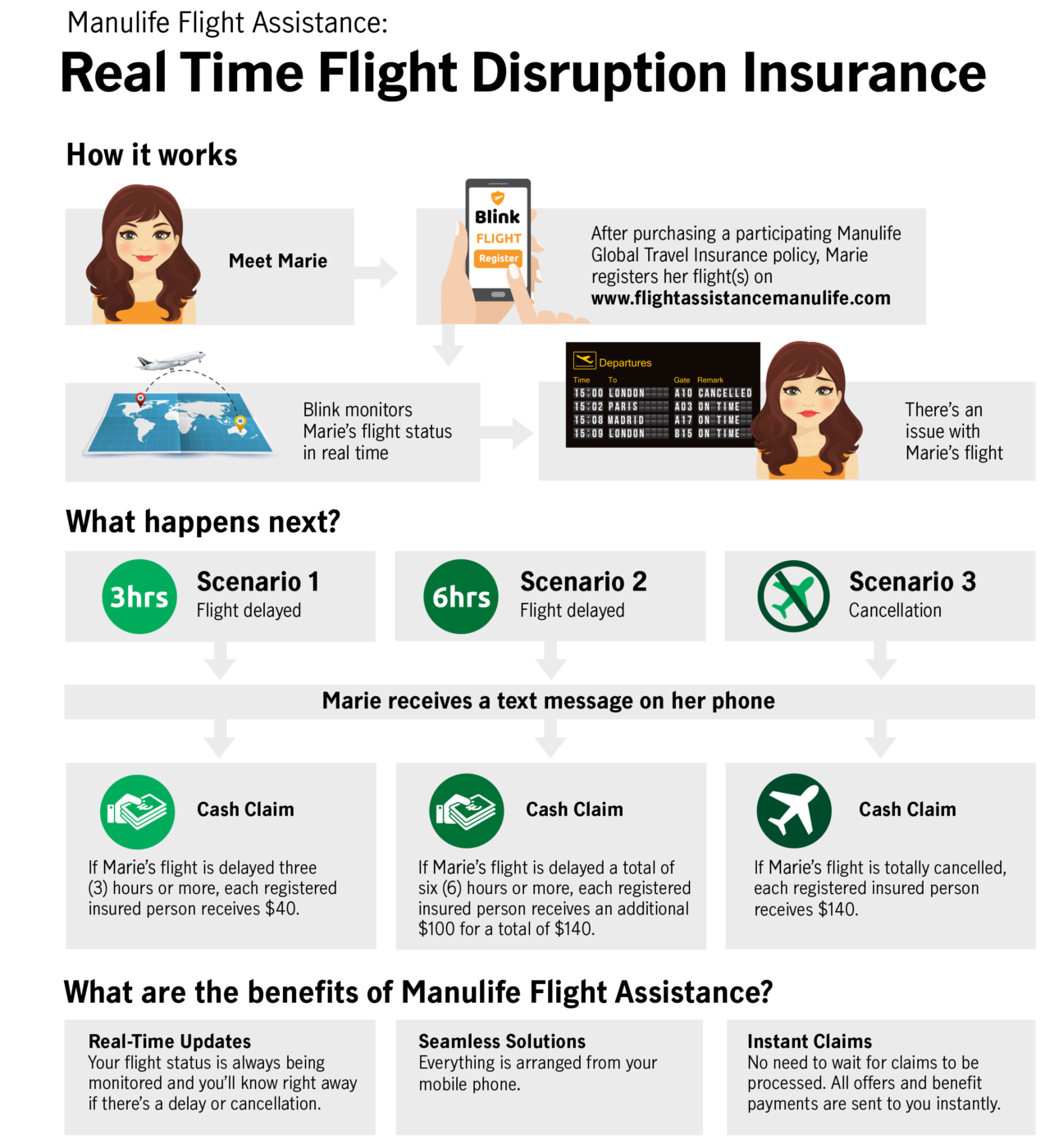



Reference: Manulife
What is trip cancellation and interruption insurance?
It’s a week before your trip and you get the sniffles…now what? Of course the sniffles can be just that — a minor inconvenience that quickly clears up before takeoff. In most cases, just a false alarm.
But it can also morph into something else, possibly interfering with the trip you’ve spent months planning and paying for.
Life being what it is, occasionally medical issues, extreme weather or other events crop up and force us to interrupt our travel plans.
Get “you-never-know” protection
If you already have travel insurance, check your policy. It may already have coverage for trip cancellation or trip interruption. If so, make sure you have enough coverage. If not, it’s a good idea to add or top up, especially as you’re investing a lot of time and money in your trip.
What’s the difference between trip cancellation and trip interruption insurance? Trip cancellation kicks in if certain medical or non-medical events occur before you leave home, so you’re reimbursed on all or some costs, depending on your coverage. Trip interruption reimburses you if a similar set of events occur after you leave home and during your trip and you’re forced to return home.
Check your policy, if you have one, and talk to a licensed agent before planning your trip. Generally, coverage can vary depending on a number of factors, including:
- Pre-existing medical conditions, such as diabetes, cancer or a pregnancy.
- When you booked your trip, when you bought travel insurance and when the event forcing you to cancel or interrupt occurs
- Your traveling companion’s coverage
- When you make a claim
So plan your travel with confidence, and never mind those sniffles.
1. What is travel insurance?
Travel insurance helps protect you from unexpected costs while travelling. This can include emergency medical expenses, trip cancellation and trip interruption costs, delayed or lost baggage, and flight and travel accidents.
2. What does travel insurance cover?
Travel insurance can include coverage for hospital and physician services, paramedical services, ambulance and emergency medical return home, and more. In addition, travel insurance can also help with unexpected costs from delayed or lost baggage, trip cancellation and trip interruption, and flight and travel accidents.
3. When is the best time to purchase travel insurance?
Many insurance plans may be purchased right up until the date of departure, however, if you are considering coverage for trip cancellation it is recommended to purchase insurance on the day your trip is booked.
4. Does my provincial health insurance cover travel abroad?
Provincial or territorial government health insurance plans may pay only a small portion of medical expenses incurred abroad. They might not pay for ambulance services, prescription drugs, fees charged by private hospitals or facilities or emergency dental treatment. In addition, many hospitals abroad may require immediate cash payment or proof of insurance, which our assistance centre would help coordinate.
5. What happens if I’ve booked a trip and one of my family members becomes ill or passes away?
Trip Cancellation and Interruption insurance benefits may be payable in the event that any member of your immediate family develops a medical condition unexpectedly or passes away and you can no longer travel or you need to end your trip early.
6. Do your travel insurance plans cover me during pregnancy?
If you’re planning to travel while pregnant, our plans can help protect you while you’re away. However, the following coverage exclusions apply:
- Routine pre-natal or post-natal care
- Pregnancy, childbirth and complications of pregnancy and childbirth in the 9 weeks before or after your expected due date
- A child born during your trip
7. Can I cover my grandchild under a family travel insurance plan?
A dependent grandchild meets our definition of “child.” To be covered, your grandchild must be named on your confirmation and be travelling with you. Keep in mind that all travellers covered under a family travel insurance plan must be under age 60.
Reference: Manulife

Travelling out of province?
Monica shares why travel insurance is important even within Canada.
Source: Manulife
Monica S. and her husband live in Calgary, Alberta. Their active lifestyle includes skiing, hiking and biking, often in faraway locations such as Europe, New Zealand and Hawaii. For many years, they have relied on travel insurance to help protect them on their adventures. They have a convenient 30-day multi-trip plan that covers them for the whole year as long as each trip isn’t more than a month.
On a recent trip to British Columbia, they used their travel insurance for a claim that would have had a significant financial impact had they not had the right protection. We sat down with them to talk about what happened.
Have you always travelled with insurance?
One time we went to Hawaii, and we didn’t have travel insurance. My husband and I were walking in the volcanoes when he fell through the very thin volcanic crust. He put his hand down to catch himself and got a deep gash through his palm. We took him to the hospital, and it cost about $1,800 per stitch, which we had to pay upfront. Not only that, but they hounded him when we got back to Calgary, saying we hadn’t paid enough.
It was a terrible experience. That’s when we started to pay attention to medical insurance.
Tell us about your most recent experience.
We were vacationing in British Columbia, riding bikes in the Okanagan. They’re lovely roads but very narrow. I was trying to give the cars as much space as possible, and basically went off the road onto the gravel shoulder. I crashed and fractured my pelvis.
They took me to the Penticton hospital, where they said I would have to go to either Vancouver or Calgary for surgery. Calgary was the logical place for me, but I had to get there, and provincial healthcare programs don’t cover cross-provincial transportation. It was going to cost $16,000.
Fortunately, we had our annual coverage. So we contacted Manulife, and they said, “Yes by all means we can get you there.”
Manulife just dealt with the whole thing. They understood the seriousness of the accident and were in touch with the hospital and the doctors right away. I was in hospital about 10 days, but now I’m good as new.
The insurance covered it all. If I had not had that insurance, well, I don’t know. I was very grateful.
“That made us realize that coverage when travelling in a different province is just as important as coverage when travelling internationally.”
What did you take away from that experience?
It was a revelation to us that you need travel insurance for trips within Canada. The more we dug into it, the more we began to appreciate that there are very significant discrepancies in insurance plans province to province. That made us realize that coverage when travelling in a different province is just as important as coverage when travelling internationally. That was the real lesson for us.
Have you made other claims over the years?
We’ve had good luck. We’ve travelled very safely around the world — New Zealand, Europe —so I guess no news is good news! But this one time, I had to make a claim for trip interruption when I was on a ski holiday. I hyperextended my knee and wasn’t able to ski. We were able to phone Manulife immediately and explain the situation and they started the claim. I missed a day and half of skiing but was able to get a refund on the cost.
How do you purchase your travel insurance?
We’ve been going direct for the last number of years. I don’t go online, I just phone. I like to talk to somebody. All our questions are answered quickly and conveniently and then we know we’ve got the right policy and are covered for all eventualities.
For example, when we wanted to go to New Zealand for more than four weeks we weren’t sure whether that was covered or what the cost of the extra time would be. By working with someone we got all that cleared up very quickly.
What would you say to people who rely on their credit card for travel coverage?
A lot of my friends get travel insurance through their credit card and think that’s good enough. I guess I’ve been always a little bit leery to trust a credit card for all of that. I’m pretty certain there are limitations to the credit card insurance option.
We tend not to skimp on travel insurance. We go for trip cancellation and medical coverage because we do a lot of travelling and we don’t want to be caught short.
Do you have any other advice you’d like to share?
For any Canadian with the intent of travelling, I would say do your homework and definitely, definitely purchase insurance. The risks are just too great, even if you’re only travelling out of province.
The other point I would like to make is that if anything goes wrong, the first thing you should do is phone your travel insurance company. That kickstarts the process.
You know, things just happen, and you can never really be sure. Sometimes nothing happens, and that’s okay, but far better to have something behind you in the event that things do take a turn for the worse.
Case: Malcolm Saved by Travel Insurance
Malcolm was having a blast on a ski trip, until his vacation went downhill. But after saving almost $17,000 on medical costs, things were looking up again.